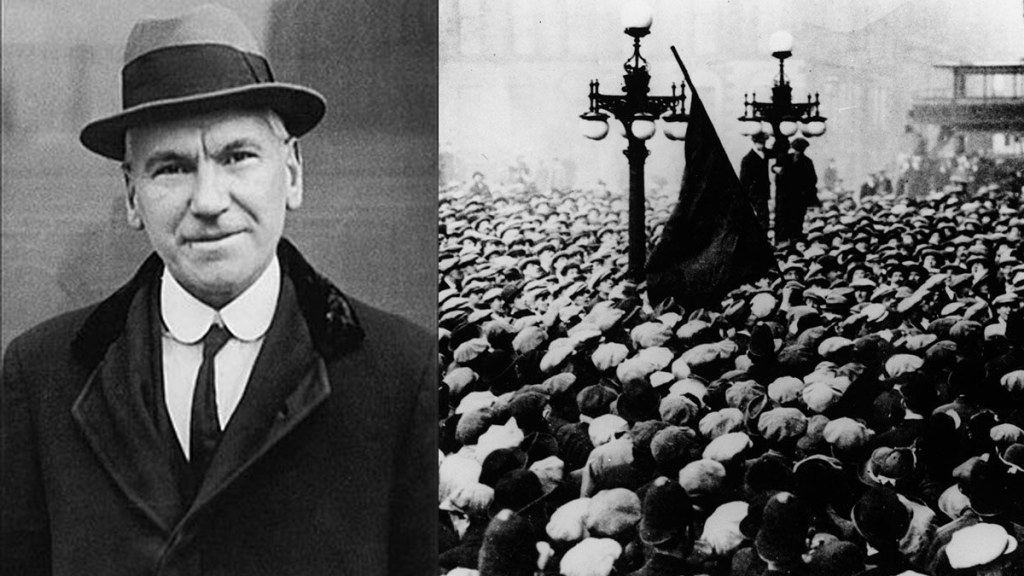
John Maclean stands as one of Scotland’s most uncompromising and visionary socialist figures. A schoolteacher turned revolutionary whose life was defined by education, agitation, and an unshakeable belief in working‑class power. His story is inseparable from the rise of Red Clydeside, and the global socialist movements that shaped the era.
Early Life and Political Awakening
Maclean was born on 24 August 1879 in Pollokshaws on the outskirts of Glasgow. His parents were Highlanders displaced by the legacy of the Clearances and instilled in him a deep awareness of injustice. His father died when Maclean was eight. Maclean eventually trained as a teacher, earning a MA from the University of Glasgow.
Though raised in a Calvinist household, Maclean rejected religion and embraced Marxism. By 1903, he had joined the Social Democratic Federation and began rebuilding its Glasgow organisation. His commitment to educating workers became the defining feature of his early activism: he taught Marxian economics and industrial history in nightly classes, producing many of the activists who would later lead the Clyde revolts.
A Revolutionary Educator
Maclean believed that socialist transformation depended on raising the political consciousness of the working class. His classes, pamphlets, and open‑air meetings across Scotland made him one of the most influential Marxist educators of his generation. He helped form the Scottish Labour College and the Labour College Committee, institutions dedicated to worker education independent of the state and employers.
He also played a central role in the Clyde Workers’ Committee, an early shop‑stewards’ movement that challenged employers and the government during wartime industrial disputes.
>Jim Larkin invited him to Belfast during the 1907 Transport Workers’ Strike, extending his influence beyond Scotland and marking his first major involvement in Irish labour struggles.
Opposition to World War I
Maclean’s fierce opposition to World War I defined his public reputation. He condemned the conflict as an imperialist war that pitted worker against worker, and his anti‑war speeches drew huge crowds. His stance led to repeated arrests under the Defence of the Realm Act. In 1916 he was imprisoned for statements allegedly “likely to prejudice recruiting” and “cause mutiny.” McLean served 14 months in prison before mass protests forced his release.
Authorities arrested him again for sedition in April 1918. His 75‑minute speech from the dock – a defiant defence of socialism – became a celebrated text of Scottish radicalism. The court sentenced him to five years’ penal servitude but released him after the Armistice.
International Recognition and Scottish Republican Socialism
Maclean’s reputation reached far beyond Britain. Lenin appointed him Honorary President of the First All‑Russian Congress of Soviets and later Bolshevik Consul for Scotland, recognising his unwavering support for the Russian Revolution.
Yet Maclean increasingly clashed with the British left, rejecting the newly formed Communist Party of Great Britain. He believed Scottish workers, shaped by clan traditions and a distinct national history, were uniquely positioned to lead a socialist revolution — an idea he called “Celtic communism.” In 1922 he founded the Scottish Workers’ Republican Party, advocating an independent Scottish workers’ republic as the fastest route to world revolution.
Final Years and Legacy
Years of imprisonment, hunger strikes, and force‑feeding permanently damaged Maclean’s health. He collapsed during a speech in 1923 and died of pneumonia on 30 November, aged just 44.
Today, Maclean is remembered as the intellectual engine of Red Clydeside and a founding figure of Scottish republican socialism – a man who believed education could ignite revolution, and who gave his life to that cause.
